
SORCERER (1977)
THRILLER | ACTION

Four fugitives with murky pasts, shady morals, and even more dismal luck find their lives intersecting in the sweltering and godforsaken town of Porvenir, somewhere in South America. Desperate to find a way out, they agree to drive two trucks full of unstable nitroglycerin through a jungle that seems to actively want them dead. It’s a thankless mission filled with danger and FEAR, but they expect to be well-compensated for their efforts by the substantial WAGES they will be paid. Given that this story revolves around these “wages of fear”, it seems only natural that it should be called… Sorcerer?
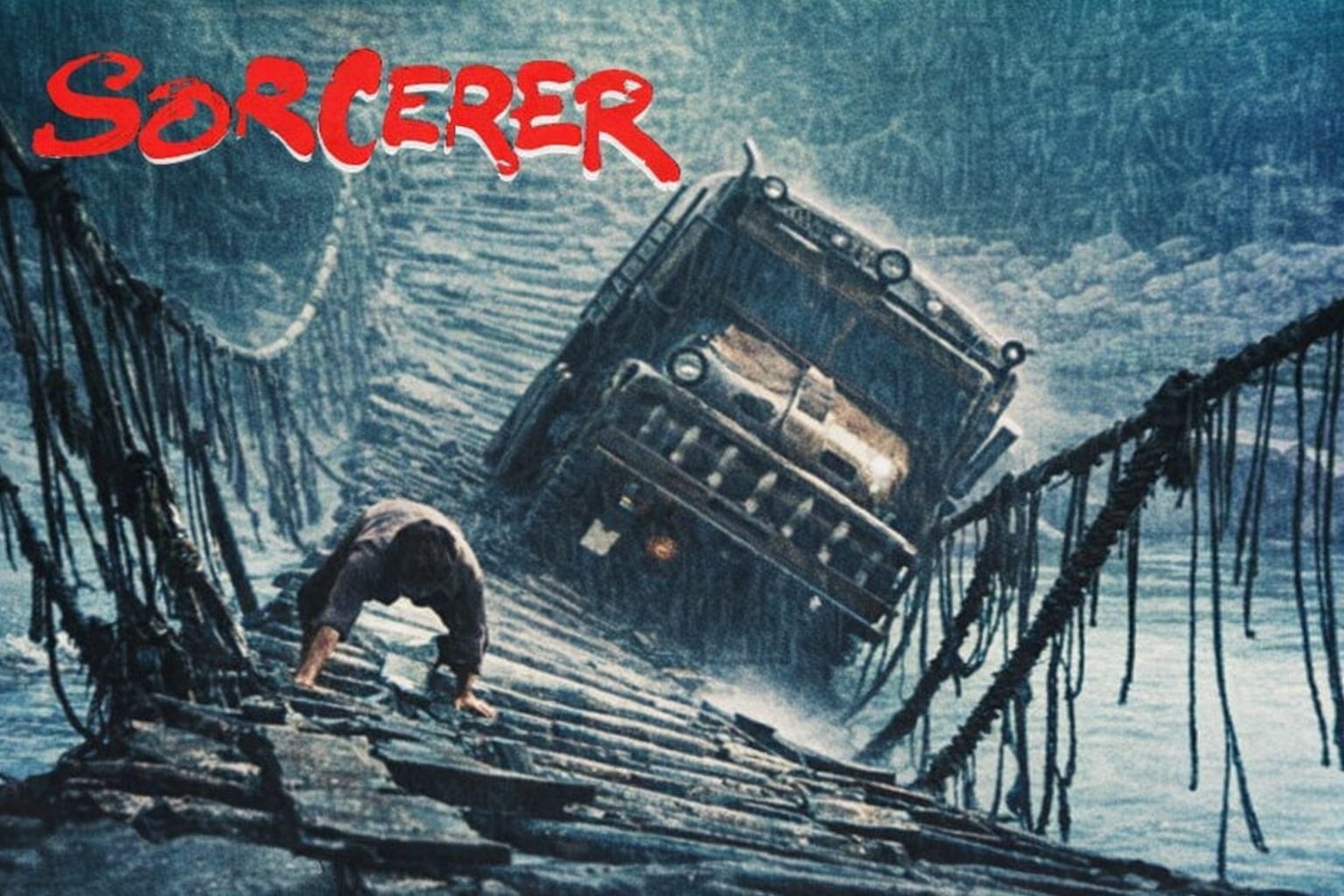
For some time now, I’ve been wanting to do a double-bill review of The Wages of Fear (1953) and its 1977 remake, Sorcerer. I first saw this when it was rereleased in cinemas in 2017, before I had even seen the original (in full, at least; I had definitely caught some key sequences), and watching it on the big screen was an overwhelming experience. I was curious to return to it nearly a decade later and analyse it through a different lens having seen and loved its predecessor. Sorcerer was a huge flop on its release, but has since been reassessed as a forgotten masterpiece. Well, I’ll be the judge of that!
PURE MAGIC
+ While masterpiece might be a bit of a stretch, there are aspects of Sorcerer which are truly astounding. Director William Friedkin takes a very different thematic approach to the material than Henri-Georges Clouzot in The Wages of Fear. While Clouzot focused on character psychology and suspense, Friedkin employs a much grittier, more muscular style, shifting the emphasis to visceral action and suffocating atmosphere.
+ As the name Sorcerer (somewhat) suggests, this version has a more mystical sensibility, at times bordering on the outright surreal. The human characters are swallowed by their wild and nihilistic environment, and the invocation of Pazuzu from The Exorcist (1973) in the native artwork enhances the sense that this is a spiritual battle more than an emotional one.
+ In an interesting change from the original, screenwriter Walon Green takes time to set up the characters before the story proper gets started. It’s only when they finally come together that the main thrust of the narrative is set in very slow and deliberate motion, from which point the tension is ratcheted with every grinding turn of the truck’s wheels.
+ The filmmakers recreate many of the key sequences from the original, but there is one new set-piece on a rope bridge that is genuinely astounding. If you’re inured to weightless and anaemic CGI, then roll up your sleeve and prepare to mainline some old-school ferocity! I’ve never seen genuine peril captured onscreen like this, and I can’t fathom how they achieved it without violating every safety standard imaginable (oh right; it’s because that’s exactly what they did!).
+ Cinematographers John M. Stephens and Dick Bush place the camera at the heart of the action so you can practically feel the heat, sweat, and dirt of this world. John Box’s production design brings the jungle alive around you, while Bud S. Smith and Robert K. Lambert’ editing wrings every moment of tension for what it’s worth. Throw in a mesmerising score by Tangerine Dreams and you’ve got yourself one memorable night at the movies.
VILE SORCERY
- In the original, we live with the characters and watch as their camaraderie grows. Here, they are on individual journeys that happen to converge at a key moment, so we aren’t afforded any time to invest in their interpersonal relationships. We never get under their skins, making this a much more solipsistic viewing experience.
- The changes to the script complicate the beautiful simplicity that worked so well before. The differing backstories are interesting on paper, but don’t actually add anything meaningful. While these additions don’t quite trip the story up, they do make it stumble. Also, twenty years on, the colonial stereotype of a wild foreign region that needs to be tamed by the West is still unpalatable.
- The emphasis on high-octane action really stretches the believability of how much jostling the “highly unstable” nitroglycerin can take before blowing up. Sure, it’s cinematic, but it undermines the severity threat.
- Sorcerer is a genuinely terrible name for this film! It makes it sound like a fantasy or a horror, which it simply isn’t (though it is at times both fantastical and horrific). Friedkin said he chose it to represent the “evil wizard of fate,” and also that he was inspired by Miles Davis’ album of the same name. Whatever. Those are stupid reasons and this is the wrong name.
Wondering where to watch it? Check JustWatch for availability.
How do my ratings hold up? Is it more of a movie or is it a film? Let me know in the comments below! If you like what I’m trying to do here, please like, subscribe, restack, and share.
I watched Wages of fear in French many years ago. It stuck in my mind as one of the most thrilling films. I should watch Sorcerer but it had to be really good to match it!
For what it's worth, "Sorcerer" is actually the name of one of the trucks!